
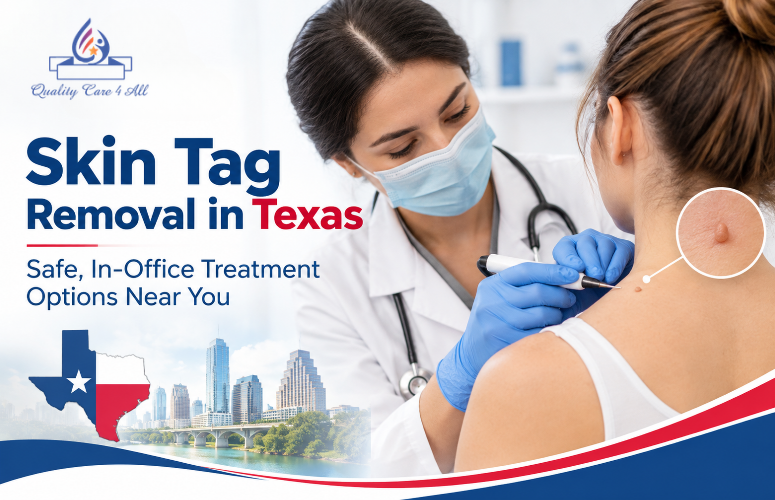
Skin tags are common skin growths that are often harmless, but they can become irritating when they repeatedly rub against clothing, jewelry, or other areas of the skin. Some people also choose removal because they are bothered by the appearance of a skin tag.
For adults considering Skin Tag Removal in Texas, professional evaluation can help determine whether a growth appears consistent with a skin tag and whether in-office removal is appropriate. This can be particularly useful when someone is unsure whether a growth is actually a skin tag or another type of skin lesion.
What Is the Safest Way to Remove a Skin Tag?
The safest approach is generally to have a healthcare professional evaluate the growth first and determine whether it appears to be a skin tag. When removal is appropriate, a healthcare professional can evaluate the growth, its location, and your individual circumstances before performing an in-office procedure with appropriate technique, bleeding control, infection precautions, and aftercare guidance.
What Is a Skin Tag?
A skin tag, medically called an acrochordon, is a small growth of tissue that commonly develops from the skin’s surface. Skin tags are generally considered benign, meaning they are not usually harmful.
They can appear in areas where skin frequently rubs against skin, clothing, or accessories. Common locations include:
- Neck
- Underarms
- Eyelids
- Groin area
- Under the breasts
- Other skin folds
A skin tag may appear soft, flesh-colored, slightly darker than surrounding skin, or attached to the skin by a small stalk.
However, not every bump or skin growth is a skin tag. Warts, moles, cysts, and other skin lesions can have different appearances and may require different approaches.
That is why identifying a growth correctly is an important part of considering in-office skin tag removal. If a growth looks unusual, changes over time, or does not clearly resemble a typical skin tag, professional evaluation may be appropriate before attempting removal.
What Causes Skin Tags?
The exact reason a particular person develops a skin tag is not always clear. Several factors may be associated with their development.
Skin Friction
Repeated friction is commonly associated with skin tags. Areas where skin touches skin or clothing repeatedly may be more likely to develop these growths.
For example, the neck may experience friction from collars or jewelry, while skin folds can experience ongoing contact between surfaces.
Skin Folds
Skin tags may occur in areas where the skin naturally folds. Repeated rubbing and irritation in these locations may contribute to their development.
Age-Related Factors
Skin tags can become more common with age. However, their presence can vary considerably from one person to another.
Family Tendency
Some people may be more prone to developing skin tags because of individual or family tendencies.
Hormonal and Metabolic Associations
Skin tags have also been associated with certain hormonal or metabolic factors. These associations do not mean that every person with a skin tag has an underlying health condition.
A healthcare professional can consider the broader clinical picture when evaluating a skin growth rather than assuming that a single factor explains its development.
When Should a Skin Tag Be Removed?
Not every skin tag needs to be removed. If it is not causing symptoms or bothering the person, removal may not be necessary.
Removal may be considered when a skin tag:
- Repeatedly catches on clothing
- Rubs against jewelry
- Becomes irritated by friction
- Is bothersome during everyday activities
- Bleeds after repeated friction or accidental catching
- Causes cosmetic concern
The decision can depend on the location, appearance, symptoms, and individual preferences.
If a growth is painful, changing, bleeding without an obvious reason, or otherwise unusual, it is better to consider medical evaluation rather than simply assuming that removal is appropriate.
What Is the Safest Way to Remove a Skin Tag?
Professional evaluation is an important first step because the safest treatment approach depends on what the growth actually is.
A healthcare professional may consider factors such as its:
- Appearance
- Size
- Location
- Number of growths
- Relationship to surrounding skin
- Symptoms
- Overall clinical circumstances
When a healthcare professional determines that a growth is suitable for removal, an in-office minor procedure may provide an option.
Professional treatment can also provide several practical advantages over attempting removal without medical guidance. These include appropriate identification of the growth, use of a suitable procedure, attention to bleeding, infection-control considerations, and instructions for caring for the area afterward.
There is not one removal technique that is universally appropriate for every person or every skin growth. The appropriate approach depends on the individual situation.
When Home Removal May Be a Concern
Cutting, tying off, burning, or using unverified products on a skin growth can create problems such as bleeding, irritation, infection, or scarring. More importantly, a person may incorrectly assume that an unusual growth is a skin tag.
A healthcare professional can evaluate the growth and help clarify whether removal may be appropriate.
What Happens During In-Office Skin Tag Removal?
The exact patient experience can vary depending on the growth and the healthcare setting. In general, an in-office visit may involve several stages.
Evaluation
The healthcare professional may first examine the growth to determine whether it appears consistent with a skin tag.
This step matters because different types of skin growths can look similar to an untrained observer.
If the growth does not appear typical or requires additional evaluation, removal may not be the immediate next step.
Treatment Discussion
If the growth appears appropriate for removal, the healthcare professional may discuss the available approach.
The appropriate procedure can depend on factors such as size, location, appearance, and other individual circumstances.
Patients can also ask questions about expected discomfort, possible marks or scarring, aftercare, and potential costs before proceeding.
Removal
When clinically appropriate, a minor procedure may be performed in the office.
The specific technique is not necessarily the same for every patient. The goal is to use an approach appropriate for the particular growth and circumstances rather than assuming that one method fits everyone.
Texans Health and Wellness Center lists Minor Procedures among its medical services and includes wart/skin tag removal as one of the available minor procedure categories. You can learn more about the broader service category through Medical Services.
The practice’s related educational resource on in-office treatments can also provide additional context about Minor Procedures.
Aftercare
After removal, the healthcare professional may provide instructions for caring for the treated area.
Following those instructions can help reduce unnecessary irritation and support appropriate care while the area settles.
Because aftercare can depend on the procedure used and the location treated, patients should follow the specific guidance provided to them rather than relying only on general online advice.
A Broader Look at Minor Procedures
Minor procedures can cover several different types of office-based treatments. For example, the broader service category may include skin tag removal as well as other procedures such as trigger point injections.
These procedures are not interchangeable, and each addresses a different clinical need. For readers interested in the broader category, Texans Health and Wellness Center also provides information about trigger point injections.
Considering Removal?
If you have a growth that appears to be a skin tag and are considering professional treatment, reviewing the available Minor Procedures information can be a useful starting point before discussing your individual situation with a healthcare professional.
Does Skin Tag Removal Hurt or Leave Scars?
The answer to “does skin tag removal hurt or leave scars” depends on several factors.
Discomfort can vary according to the procedure, location of the growth, individual sensitivity, and other circumstances. Some procedures may involve little discomfort, while others may cause temporary soreness or irritation.
Similarly, any procedure involving the skin has the potential to leave a temporary mark or, in some cases, a scar. The likelihood and appearance of a scar can vary based on the procedure, the person’s skin, the location treated, and how the area heals.
For that reason, it would not be medically responsible to guarantee that skin tag removal will be completely painless or leave no mark.
If scarring or discomfort is a major concern, discuss those concerns with the healthcare professional before treatment.
Can a Doctor Remove Skin Tags in One Visit?
A healthcare professional may address a straightforward skin tag removal during one visit, but same-day removal cannot be guaranteed.
Whether removal can occur during a particular appointment may depend on:
- The initial clinical evaluation
- Number of skin tags
- Size of the growths
- Location
- Procedure selected
- Whether the growth needs further evaluation
- Individual clinical circumstances
Some patients may need additional assessment before a healthcare professional recommends removal.
Ask the healthcare practice what they can reasonably address during your appointment based on your specific situation.
Skin Tag Removal Cost Texas: How Much Does It Cost?
One of the most common searches is “how much does skin tag removal cost in Texas?”
There is no single universal price for skin tag removal across Texas. Costs can vary between practices and may depend on several factors.
Potential factors include:
- Number of skin tags being evaluated or removed
- Size of the growth
- Location of the growth
- Procedure used
- Whether a medical evaluation is needed
- Whether removal is considered medically necessary or primarily cosmetic
- Practice-specific pricing
- Insurance plan requirements
A consultation or evaluation may also have its own cost depending on the healthcare setting.
Because pricing varies, patients should ask the practice about expected costs before treatment when possible. If you plan to use insurance, contact your insurer to confirm whether your plan covers the visit or procedure.
Is Skin Tag Removal Covered by Insurance in Texas?
Whether insurance covers skin tag removal in Texas depends on the reason for removal, the specific circumstances, and your insurance plan.
Insurance policies may treat medically necessary treatment differently from removal performed primarily for cosmetic reasons. Coverage can also depend on deductibles, copays, plan exclusions, network requirements, and other policy rules.
Some plans may require specific documentation or authorization in certain circumstances.
There is therefore no universal Texas-wide answer that applies to every patient.
Before scheduling treatment, consider contacting both the healthcare practice and your insurance company to ask:
- Is the evaluation covered?
- Is removal covered under my plan?
- Would the procedure be considered medically necessary or cosmetic?
- What deductible or copay may apply?
- Are there network or authorization requirements?
This can help you understand potential out-of-pocket costs before treatment.
Skin Tag Removal Near Me: What Should You Look For?
When searching online for “skin tag removal near me,” location is only one consideration.
Patients may also want to choose a healthcare setting where a professional can evaluate the growth before recommending removal.
Useful questions to ask include:
- Will the growth be evaluated before removal?
- Will the procedure be explained beforehand?
- Can I ask about potential discomfort or scarring?
- Will expected costs be explained?
- Will I receive aftercare instructions?
- What happens if the growth does not appear to be a typical skin tag?
- Can the practice explain whether removal is clinically appropriate?
These questions can help you make a more informed decision rather than assuming that every skin growth needs removal.
For patients researching a local healthcare practice, About Texans Health and Wellness Center provides additional information about the practice.
Skin Tag Removal Garland TX
People searching for “skin tag removal Garland TX” may be looking for a convenient healthcare setting where a professional can evaluate a bothersome skin growth and, when appropriate, address it through an office-based minor procedure.
Texans Health and Wellness Center provides Minor Procedures as part of its medical services and lists wart/skin tag removal among those procedures.
Patients who want to understand the practice and its broader healthcare services can visit Texans Health and Wellness Center.
You can also learn more about Dr Jaye Krubally and review the practice’s Medical Services.
For people in Garland and surrounding Texas communities, the key consideration remains the same: a healthcare professional should evaluate the growth before anyone assumes it is a skin tag or proceeds with removal.
When Should You Consider Professional Evaluation?
Most people do not need to panic about an ordinary-looking skin tag. However, professional evaluation may be appropriate when a growth does not clearly resemble a typical skin tag or changes noticeably.
Consider having a healthcare professional evaluate a growth if it:
- Changes noticeably in appearance
- Changes color
- Grows rapidly
- Becomes painful
- Bleeds without an obvious reason
- Looks unusual compared with your other skin growths
- Develops signs of possible infection
- Is difficult to identify as a typical skin tag
These signs do not automatically indicate a serious condition. They simply mean that assuming the growth is a skin tag may not be appropriate without an evaluation.
A healthcare professional can determine whether the growth appears suitable for routine removal or whether it needs further assessment.
Wart and Skin Tag Removal Clinic: Are They the Same Thing?
The phrase “wart and skin tag removal clinic” can make warts and skin tags sound like the same condition, but they are different types of skin growths.
Skin tags are generally soft, benign growths that commonly develop in areas affected by friction.
Warts are different skin growths and can have a firmer, rougher appearance. Their underlying cause and clinical characteristics differ from those of skin tags.
Because appearance alone can make different growths difficult to distinguish, a healthcare professional can evaluate the area when you are uncertain about what you are seeing.
Treatment should be based on the type of growth and the individual circumstances rather than simply selecting a removal method from an online recommendation.
In-Office Skin Tag Removal vs. At-Home Removal
| Consideration | In-Office Removal | At-Home Removal |
|---|---|---|
| Professional evaluation | Yes | No |
| Correct identification | Can be assessed | May be uncertain |
| Infection considerations | Professional technique | Higher uncertainty |
| Bleeding management | Professional setting | Limited |
| Aftercare guidance | Professional instructions | Self-managed |
| Best suited for | Cases evaluated as appropriate | Not a substitute for professional evaluation |
At-home removal may appear convenient, but the main concern is not simply the removal process itself. It is also the possibility of treating the wrong type of growth or creating avoidable skin problems.
Professional evaluation does not mean that every skin tag must be removed. It provides an opportunity to determine whether removal is appropriate in the first place.
What Are the Risks of Removing a Skin Tag at Home?
People sometimes consider removing a skin tag themselves because it seems small or harmless. However, home removal can create several potential concerns.
These may include:
- Bleeding
- Infection
- Skin irritation
- Scarring
- Pain or tenderness
- Incorrectly identifying the growth
- Delaying professional evaluation of an unusual growth
The risk is not necessarily that every attempt will cause a problem. Rather, the outcome can be unpredictable when a person does not know exactly what the growth is or how to manage the treated skin.
Using household tools or unverified removal methods can also make it harder to maintain appropriate hygiene and bleeding control.
For these reasons, professional evaluation is worth considering when there is uncertainty about the growth or when the person wants an in-office treatment option.
Real-Life Examples: When People Consider Skin Tag Removal
The following are hypothetical examples for education only. They are not actual patient cases, testimonials, or guarantees of treatment outcomes.
Example 1: A Skin Tag on the Neck
An adult notices a small growth on the neck that repeatedly catches on a shirt collar and occasionally becomes irritated.
Because the area experiences repeated friction, the person chooses to discuss the growth with a healthcare professional instead of attempting removal at home.
Example 2: A Growth in an Area With Frequent Friction
A person notices a small growth in an area where skin frequently rubs against clothing. It becomes bothersome during everyday activities.
The person seeks professional evaluation to determine whether it appears to be a skin tag and whether removal is appropriate.
Example 3: A Growth That Looks Different
Someone notices a growth that does not look quite like their other skin tags and appears to be changing.
Instead of assuming it is another skin tag, the person seeks professional evaluation before considering removal.
This illustrates why skin tag evaluation can matter just as much as the removal itself.
FAQs About Skin Tag Removal
The safest approach generally begins with professional evaluation to determine whether the growth appears to be a skin tag. If removal is appropriate, a healthcare professional can select an appropriate in-office approach based on the growth’s size, location, appearance, and individual circumstances.
Discomfort varies depending on the procedure, location, individual sensitivity, and other factors. Some people may experience temporary discomfort or irritation. A healthcare professional can explain what to expect from the particular procedure being considered.
Some straightforward cases may be addressed during one visit, but this is not guaranteed. The number, size, location, appearance of the growths, procedure selected, and need for additional evaluation can all affect whether removal can occur during the same appointment.
There is no single price for skin tag removal throughout Texas. Cost may vary according to the number and size of growths, location, procedure, evaluation requirements, whether treatment is medically necessary or cosmetic, practice pricing, and insurance considerations.
Home removal can carry risks such as bleeding, infection, irritation, scarring, and incorrect identification of the growth. If you are unsure whether a growth is actually a skin tag, professional evaluation may be appropriate before attempting removal.
Consider professional evaluation if a growth changes noticeably, grows rapidly, changes color, becomes painful, bleeds without an obvious reason, looks unusual, develops signs of infection, or does not clearly resemble a typical skin tag. These features do not by themselves establish a diagnosis, but they warrant appropriate assessment.
Final Thoughts on Skin Tag Removal in Texas
Skin tags are common benign skin growths. A person may consider removal when a skin tag becomes irritating, repeatedly catches on clothing or jewelry, or causes cosmetic concern.
The key step is not simply finding a way to remove a growth. It is making sure the growth is appropriately identified and that removal is suitable for the individual situation.
For adults searching for Skin Tag Removal in Texas, including people looking for skin tag removal near me or skin tag removal Garland TX, an in-office evaluation can provide an opportunity to discuss the growth, potential treatment options, expected aftercare, and costs before proceeding.
If you have a bothersome growth or are unsure whether it is actually a skin tag, consider discussing it with a qualified healthcare professional rather than attempting removal without appropriate evaluation.
To learn more about the healthcare services available through the practice, visit Texans Health and Wellness Center.
Contact Us: Texans Health and Wellness in Texas