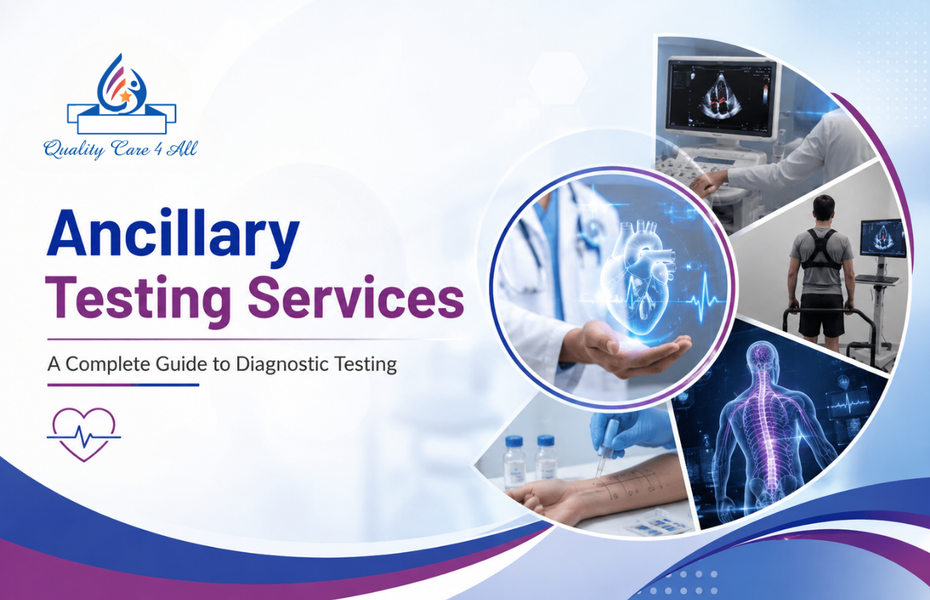
Have you ever wondered why a healthcare provider may recommend an additional test after discussing your symptoms and medical history?
That is where ancillary testing services can become an important part of a broader medical evaluation. These services generally provide additional information that may help a healthcare professional better understand a patient’s symptoms, assess a particular body system, or determine appropriate next steps.
Ancillary testing does not automatically provide a diagnosis, and not every patient needs the same tests. The right approach depends on individual symptoms, medical history, clinical findings, and professional judgment.
For people researching diagnostic testing in Texas, understanding what these tests do—and what they do not do—can make the healthcare process easier to navigate.
What Are Ancillary Testing Services?
Ancillary testing services are diagnostic or supportive tests performed alongside a primary healthcare evaluation. They can provide additional information about specific body systems, symptoms, or health concerns and may help healthcare professionals support diagnosis, monitoring, or further evaluation when clinically appropriate.
What Is Ancillary Testing in Healthcare?
In healthcare, ancillary testing generally refers to diagnostic or supportive testing performed in addition to a patient’s primary clinical assessment.
A healthcare provider may gather information through a conversation about symptoms, medical history, physical examination, and other clinical observations. Sometimes, that information is enough to determine the next step. In other situations, additional testing may provide useful information.
Depending on the circumstances, ancillary testing may help healthcare professionals:
- Evaluate specific symptoms
- Investigate possible causes of a health concern
- Assess the function of a particular body system
- Gather information that supports a suspected diagnosis
- Monitor certain health concerns
- Determine whether additional evaluation may be appropriate
- Support clinical decision-making
The important point is that testing is one part of the healthcare evaluation, rather than a replacement for professional medical assessment.
What Does “Ancillary” Mean in Healthcare?
The word ancillary generally means something that provides additional support to a primary service or process.
In healthcare, the term can therefore describe services that complement the main clinical evaluation. If you want a more detailed explanation of the terminology, read ancillary meaning.
Understanding this distinction helps explain why ancillary testing can be useful without being the same thing as a complete medical diagnosis.
Why Do Doctors Recommend Ancillary Testing?
A healthcare provider may recommend additional testing when they need more information to evaluate a patient’s symptoms, medical history, or specific health concerns.
Why do doctors recommend ancillary testing?
There are several possible reasons.
1. To gather additional clinical information
Symptoms can sometimes have multiple possible explanations. A relevant diagnostic test may provide information that is not available from symptoms alone.
2. To support a suspected diagnosis
Testing may provide objective information that supports or challenges a clinical possibility being considered by a healthcare professional.
3. To investigate possible causes
When symptoms are persistent or unexplained, appropriate testing may be one part of investigating what could be contributing to them.
4. To assess a particular body system
Some tests focus on specific areas of the body or physiological functions. The choice depends on the patient’s circumstances.
5. To monitor an existing concern
Certain tests may be used to gather information over time when monitoring is clinically appropriate.
6. To guide the next step
Test results can help a healthcare professional decide whether the patient needs additional evaluation, monitoring, or another appropriate next step.
Healthcare professionals select tests based on each individual’s symptoms, medical history, and specific healthcare needs rather than simply ordering unnecessary tests.
What Types of Ancillary Testing Services Are Available?
The types of ancillary testing services available can vary from one healthcare setting to another. At Texans Health and Wellness Center, the services provided include echocardiogram, balance testing, autonomic nervous system testing, and allergy testing and immunotherapy.
Echocardiogram
An echocardiogram is a type of cardiovascular diagnostic test that uses ultrasound to create images of the heart.
It can provide information about aspects of heart structure and function. Depending on the clinical situation, an echocardiogram may help a healthcare professional evaluate certain cardiovascular concerns.
An echocardiogram is not interpreted in isolation. A healthcare professional considers the test findings alongside the patient’s symptoms, history, examination, and other relevant information.
Balance Test
Balance testing can provide information about balance-related function and may be considered as part of a broader clinical evaluation.
Because balance concerns can involve different factors, a healthcare professional may review your symptoms and medical history before deciding whether an assessment is appropriate.
A balance test may therefore be one component of a broader evaluation rather than a standalone explanation for every balance-related symptom.
Autonomic Nervous System Testing (ANS)
The autonomic nervous system (ANS) helps regulate many functions that occur automatically in the body, including processes involving heart rate, blood pressure, digestion, and other physiological responses.
ANS testing can provide information about autonomic responses and may help a healthcare professional evaluate certain symptoms or concerns related to autonomic function.
The meaning of the results depends on the test performed and the individual’s overall clinical picture.
Allergy Testing & Immunotherapy
Allergy testing can help evaluate whether a person has sensitivity to specific allergens.
A healthcare professional may recommend allergy testing when a patient’s symptoms or medical history suggest that allergies could play a role. However, no single allergy test can identify every possible allergy.
Immunotherapy is a treatment approach involving controlled exposure to specific allergens with the goal of changing the body’s response over time. Whether it is appropriate depends on the individual’s allergies, symptoms, medical history, and professional evaluation.
Diagnostic Testing Comparison Table
| Test | General Purpose | What It May Help Evaluate | When It May Be Considered |
|---|---|---|---|
| Echocardiogram | Evaluates heart structure and function | Certain cardiovascular concerns | When clinically appropriate |
| Balance Test | Evaluates balance-related function | Dizziness or balance concerns | Based on symptoms and clinical assessment |
| ANS Testing | Evaluates autonomic nervous system responses | Certain autonomic concerns | When medically indicated |
| Allergy Testing | Helps identify specific allergic sensitivities | Possible allergies | Based on symptoms and medical history |
The appropriate test depends on the individual’s circumstances. A healthcare professional can determine which diagnostic approach, if any, is suitable.
Can Ancillary Testing Help Find the Root Cause of Symptoms?
People often search for root cause diagnostic testing when they have symptoms that persist without an obvious explanation.
What tests are done to find root cause of symptoms?
There is no single test that can identify the root cause of every symptom.
Symptoms may have multiple possible causes, and the appropriate diagnostic approach depends on factors such as:
- Medical history
- Current symptoms
- Physical findings
- Existing health conditions
- Risk factors
- Previous test results
- Clinical judgment
Ancillary testing can provide additional information that may help a healthcare professional investigate possible causes.
For example, if a person has balance-related concerns, a balance assessment may provide information relevant to that concern. Similarly, an echocardiogram may provide information about heart structure and function when cardiovascular evaluation is clinically appropriate.
The key is that testing should answer a relevant clinical question.
Results also need to be interpreted in context. An abnormal result does not necessarily mean a particular disease is present, and a normal result does not always explain every symptom.
What Are In-House Diagnostic Testing Services?
In-house diagnostic testing services generally refers to testing that is available through the same healthcare facility where a patient receives other aspects of care.
The potential advantage of this model is that patients may be able to discuss their concerns and testing needs within the same healthcare setting, depending on the services available.
However, it is important not to assume that every diagnostic test is available at every clinic.
Texans Health and Wellness Center provides the ancillary testing services specifically listed in this guide. Patients can review the clinic’s broader offerings through Medical Services.
What Is an On-Site Medical Testing Clinic?
An on-site medical testing clinic generally describes a healthcare setting where certain diagnostic or assessment services are available at the facility itself.
For patients, knowing what services a clinic actually provides can be more useful than simply searching for a broad category of testing.
Before scheduling an appointment, consider asking:
- Which test do I need?
- Is the test available at this location?
- Do I need an appointment?
- Is any preparation required?
- How are results reviewed?
- Will additional follow-up be necessary?
Availability, scheduling, and clinical appropriateness can vary by test and patient.
How Do I Find Comprehensive Diagnostic Services Near Me?
When people search for comprehensive diagnostic services near me, they are often looking for a healthcare provider that offers appropriate testing alongside professional evaluation.
If you’re comparing diagnostic testing options in Texas, consider the following:
Types of tests offered
Start by determining whether the clinic provides the type of testing relevant to your concern.
Medical oversight
Diagnostic testing should be connected to appropriate healthcare evaluation and interpretation.
Communication
Ask how test results are communicated and whether a healthcare professional will discuss what the findings may mean.
Clinical appropriateness
More testing is not necessarily better. The right test depends on the patient’s circumstances.
Follow-up
Consider what happens after testing and whether additional evaluation may be recommended.
Location and accessibility
For people in and around Garland, Dallas, Fort Worth, and other Texas communities, location can also be an important practical consideration.
Texans Health and Wellness Center is one option for people interested in learning more about its listed ancillary testing services. You can visit the Texans Health and Wellness Center website to learn more about the clinic.
Can I Get Same-Day Diagnostic Testing Near Me?
A search for same day diagnostic testing near me does not necessarily mean a particular test will be available on the same day.
Same-day availability can depend on:
- The type of test
- Appointment availability
- Clinic scheduling
- The patient’s circumstances
- Whether testing is medically appropriate
- Any preparation requirements
If you need diagnostic testing, contact the healthcare facility beforehand to ask about availability and preparation requirements rather than assuming same-day testing is guaranteed.
What Should You Expect During Ancillary Testing?
Although the experience varies depending on the test, a general diagnostic testing process may involve several steps.
1. Discuss your concerns
You may first discuss your symptoms, medical history, medications, previous diagnoses, or other relevant information with a healthcare professional.
2. Determine whether testing is appropriate
The healthcare professional can determine whether additional testing may provide useful information.
3. Receive test instructions
Depending on the test, you may receive instructions about preparation, what to expect, or what information you should provide.
4. Complete the test
The procedure depends on the specific test. An echocardiogram, balance assessment, ANS test, and allergy testing are different types of evaluations and should not be expected to follow the same process.
5. Review the findings
Test results need to be interpreted appropriately. A healthcare professional may consider the findings together with symptoms, medical history, and other clinical information.
6. Discuss next steps
Depending on the findings, additional evaluation, monitoring, or other appropriate care may be considered.
Real-Life Hypothetical Examples
The following examples are hypothetical and are intended only to illustrate how ancillary testing may fit into a broader evaluation.
Persistent Symptoms
A patient has ongoing symptoms that have not been fully explained by the initial clinical evaluation. Depending on the symptoms and medical history, a healthcare professional may recommend a specific diagnostic test to gather additional information.
The test itself does not automatically establish the cause. Its findings become one part of the overall evaluation.
Balance-Related Concerns
A patient reports recurring balance concerns. After discussing the symptoms and relevant history, a healthcare professional may determine that balance testing could provide useful additional information.
The results would then be considered alongside the patient’s broader clinical picture.
Possible Allergies
A patient experiences symptoms that could be associated with an allergic response. Based on the person’s symptoms and history, a healthcare professional may consider allergy testing to investigate specific sensitivities.
The test does not necessarily identify every possible trigger, which is why clinical history remains important.
How Does Diagnostic Testing Fit Into Preventive Healthcare?
Diagnostic testing and preventive screening are related but are not the same thing.
Diagnostic testing is generally used when there is a symptom, concern, finding, or clinical question that needs further evaluation.
Preventive diagnostic screening generally refers to testing people who may not have symptoms, with the goal of identifying certain health risks or conditions according to established screening recommendations.
Monitoring is different again. It involves evaluating a known or previously identified concern over time.
Not every ancillary test is a preventive screening test. Whether a test is appropriate for screening, diagnosis, or monitoring depends on the test and the individual’s circumstances.
How Does Ancillary Testing Compare With Other Diagnostic Services?
Healthcare includes many different forms of diagnostic evaluation.
Diagnostic imaging can create images of internal structures and may include different technologies depending on the clinical question.
Lab and diagnostic services can analyze blood, urine, or other biological samples when appropriate.
Specialty medical testing may focus on a particular body system, function, or health concern.
Point-of-care testing generally refers to certain tests performed close to or at the location where the patient receives care.
These approaches serve different purposes. A healthcare professional selects testing based on the clinical question rather than simply choosing the most extensive testing available.
When Should You Ask About Ancillary Testing?
You may want to discuss the possibility of additional testing with a healthcare professional if you have:
- Persistent symptoms
- Unexplained symptoms
- New or changing health concerns
- Symptoms involving a particular body system
- A known health issue that requires monitoring
- Questions about whether further evaluation is appropriate
That does not mean everyone with these concerns needs ancillary testing.
A healthcare professional can determine whether testing is appropriate based on your individual situation.
Texans Health and Wellness Center and Ancillary Testing
For patients researching ancillary testing in Garland or diagnostic testing options in Texas, understanding the available services is an important first step.
Texans Health and Wellness Center offers the ancillary testing services covered in this guide:
- Echocardiogram
- Balance Test
- Autonomic Nervous System Testing (ANS)
- Allergy Testing & Immunotherapy
The purpose of these services is to provide relevant diagnostic or supportive information as part of appropriate healthcare evaluation.
To learn more about the clinic and its approach, visit About Texans Health and Wellness Center. You can also learn more about Dr Jaye Krubally and explore the clinic’s available services.
For readers in Garland, Dallas, Fort Worth, and surrounding Texas communities, the priority is not simply finding a test—it is choosing an appropriate evaluation based on the health concern and individual needs.
If you have persistent, unexplained, or specific health concerns, consider discussing your symptoms with an appropriate healthcare professional before deciding which tests you need.
Texans Health and Wellness Center offers several ancillary testing services that may support a broader clinical evaluation when appropriate. Review the available services and discuss your testing needs with the healthcare team.
FAQs
Ancillary testing in healthcare refers to diagnostic or supportive tests performed in addition to a primary clinical evaluation. These tests can provide additional information that may help evaluate symptoms, assess specific body systems, or support clinical decision-making.
Examples include echocardiograms, balance testing, autonomic nervous system testing, and allergy testing. The services available vary by healthcare facility.
The process varies by test. Generally, you may discuss your symptoms and medical history, determine whether testing is appropriate, complete the selected test, review the findings with an appropriate healthcare professional, and discuss potential next steps.
Same-day availability varies by test type, appointment availability, scheduling, preparation requirements, and medical appropriateness. Contact the clinic directly to confirm whether a particular test is available when you need it.
Compare providers based on the tests they offer, appropriate medical oversight, communication about results, follow-up options, location, and whether the services are suitable for your specific healthcare needs.
Conclusion
Ancillary testing services can provide valuable additional information when a healthcare professional needs to investigate symptoms, evaluate a specific body system, monitor a concern, or support a broader clinical assessment.
The important distinction is that diagnostic testing is not a substitute for professional medical evaluation. No single test can explain every symptom or identify every possible cause. The appropriate testing approach depends on the patient’s history, symptoms, clinical findings, and medical needs.
For patients in Garland, Dallas, Fort Worth, and surrounding Texas communities, Texans Health and Wellness Center provides several ancillary testing options, including echocardiogram, balance testing, ANS testing, and allergy testing and immunotherapy.
Learning what each service does can help you have a more informed conversation with your healthcare professional about whether testing is appropriate for you.
If you are researching diagnostic testing in Texas and want to understand whether ancillary testing may be relevant to your healthcare needs, explore the available services at Texans Health and Wellness Center.
You can also review the clinic’s Medical Services to learn more about the available options. Discuss your symptoms and testing questions with an appropriate healthcare professional so that any diagnostic evaluation is selected based on your individual circumstances.
Contact Us: Texans Health and Wellness in Texas