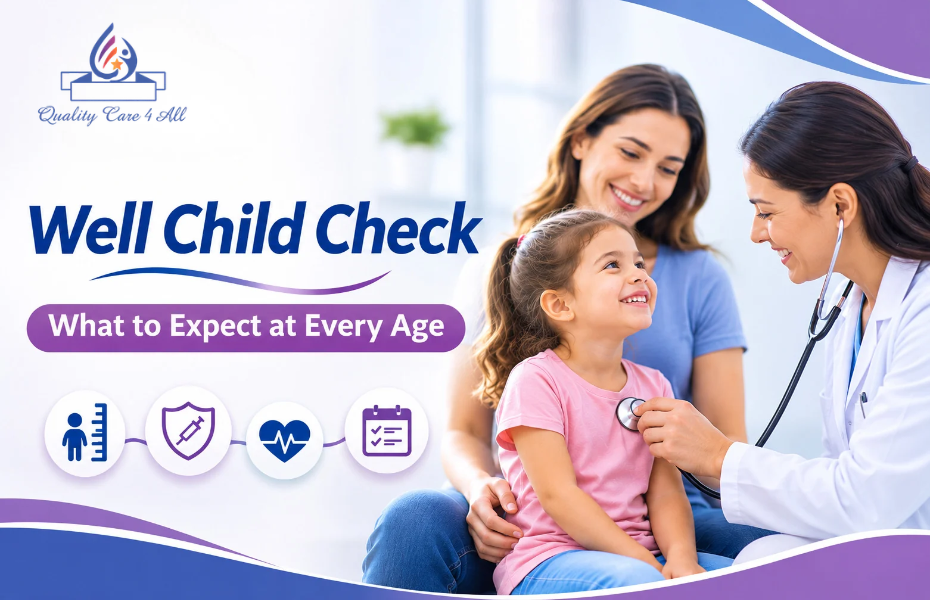
A well child check is one of the simplest ways to protect your child’s health. It happens when your child feels fine, and that is the point. The doctor tracks growth, checks development, updates vaccines, and answers the questions that keep parents up at night.
At Texans Health and Wellness Center in Garland, Texas, we see families at every stage. This guide explains what happens at each age, why it matters, and how to get ready.
What Is a Well Child Check?
A well child check is a routine preventive visit with your child’s doctor, even when your child is healthy. The doctor measures growth, reviews development, gives needed vaccines, completes screenings, and answers your questions, so small concerns are caught early and your child stays on track.
What Happens at a Well Child Check?
At a well child check, the nurse measures height and weight, plus blood pressure for older kids. The doctor does a full physical exam, reviews development and health history, gives any vaccines that are due, and completes age-appropriate screenings. Then you get time to ask questions.
Some families call this a well child visit, a well child exam, or an annual checkup for kids. They all mean the same thing. Here is what usually happens:
- Growth tracking: Your child’s height, weight, and head size (for babies) are plotted over time to show a healthy pattern.
- Health history: The doctor asks about eating, sleep, activity, school, and any recent illnesses.
- Physical exam: The doctor listens to the heart and lungs, checks eyes, ears, mouth, skin, and more.
- Vaccines: Immunizations are given based on your child’s age and records.
- Screenings: These may include development, vision, hearing, and mental health checks.
- Parent Q&A: You get answers and practical advice for the months ahead.
How Often Should a Child Have a Well Child Checkup?
Babies need the most visits: at the newborn stage, 3–5 days, then 1, 2, 4, 6, 9, 12, 15, 18, 24, and 30 months. After that, children go once a year from age 3 through 21. This follows the American Academy of Pediatrics (AAP) Bright Futures schedule.
Missed a visit? You can still catch up. Just call and ask.
What Is the Well Child Visit Schedule by Age?
The AAP Bright Futures schedule calls for visits at the newborn stage, 3–5 days, and at 1, 2, 4, 6, 9, 12, 15, 18, 24, and 30 months. From age 3 to 21, children have one visit every year. Vaccines and screenings are added at specific ages, as shown below.
| Age | Typical visit timing | What happens | Vaccines/screenings commonly due |
|---|---|---|---|
| Newborn to 1 month | Newborn, 3–5 days, 1 month | Weight checks, feeding, sleep safety, parent support | Hepatitis B; newborn screening, including hearing |
| 2–6 months | 2, 4, 6 months | Growth, head control, smiling, feeding | Rotavirus, DTaP, Hib, polio, and pneumococcal series; flu vaccine can begin at 6 months |
| 9–12 months | 9, 12 months | Crawling, babbling, first words, sleep | Developmental screening at 9 months; lead and anemia checks around 12 months; MMR, chickenpox, hepatitis A start at 12 months |
| 15–30 months | 15, 18, 24, 30 months | Language, walking, behavior, routines | Developmental and autism screening at set visits; DTaP booster at 15–18 months |
| 3–5 years | Yearly | Speech, social skills, school readiness | Vision screening; kindergarten boosters at 4–6 years |
| 6–10 years | Yearly | School, nutrition, sleep, activity, screen time | Vision and hearing checks at set ages; yearly flu vaccine |
| 11–21 years | Yearly | Puberty, mental health, private time with the doctor | Tdap, HPV, and meningococcal vaccines; booster at 16; depression screening |
Your doctor confirms exactly what is due using CDC immunization guidance and your child’s records. For a deeper look at every stage, see our Pediatric Care guide.
Newborn and Infants (Well Baby Checkup)
A well baby checkup focuses on feeding, weight gain, sleep, and safe sleep habits. The doctor checks your baby’s head, hips, heart, and reflexes. Visits are frequent in the first year because babies change fast.
This is also when parents ask the most questions, and that is welcome.
Toddlers (12–30 Months)
Toddler visits track walking, talking, and behavior. The doctor may ask how many words your child uses or how they play. Growth and development milestones are checked at set visits, and routine vaccines continue.
Preschool (3–5 Years)
Yearly visits begin at age 3. Expect vision screening, speech and social checks, and a talk about school readiness. Many children get kindergarten booster vaccines between ages 4 and 6.
School-Age Children (6–10 Years)
At this age, the doctor looks at growth, nutrition, sleep, activity, and learning. This is also the time for school forms. Trouble reading the board or frequent headaches are worth mentioning.
Teens (11–21 Years)
Teen visits add puberty, mood, stress, and healthy choices. Teens often get part of the visit alone with the doctor, which builds responsibility and trust. Vaccines at this age include Tdap, HPV, and meningococcal.
Not sure when your child’s next visit is due? Call us at (972)303-0861 and we will help you find out.
Why a Well Child Exam Matters
Preventive care for children works best when it is steady. Here is what regular visits do:
- Early detection: Doctors can spot growth, vision, hearing, or development concerns before they grow.
- Vaccines on time: Childhood immunizations protect your child and the community.
- Development support: Milestone checks help you act early if your child needs extra help.
- Mental health: Doctors ask about mood, sleep, stress, and school, especially for teens.
- Trust: Seeing the same doctor builds comfort, which is a big part of Pediatric Primary Care.
Vision and Hearing Screening, Immunizations and Sports Physicals
Vision and hearing screening. Newborns get a hearing screen, and vision screening starts at age 3. Later checks happen at set ages or when a concern comes up. Early detection helps children learn and play with confidence.
Immunizations. Vaccines follow the CDC schedule and are updated at well visits. Bring your child’s records so nothing is repeated or missed.
Sports physicals. Many Texas schools and leagues ask for a sports physical before the season. The doctor checks the heart, joints, strength, and health history. Bring the form your school gave you. You can see the pediatric services we offer on our Medical Services page.
How to Prepare for Your Child’s Visit
A little planning makes the visit smoother.
Checklist:
- Bring your insurance card and photo ID.
- Bring vaccine records and any school or sports forms.
- List medicines, vitamins, and allergies.
- Write down questions before you go.
- Bring a snack, a toy, or a favorite book for little ones.
- Wear easy-to-remove clothing for your child.
What Questions Should I Ask at My Child’s Well Visit?
Ask about anything on your mind: sleep, feeding, behavior, screen time, school, or mood. The best questions are specific to your child. Writing them down before the visit helps you remember. There are no silly questions, and your doctor wants to hear your concerns.
Questions to ask the doctor:
- Is my child growing and developing as expected?
- Which vaccines are due today, and which are next?
- What should I watch for before the next visit?
- Is my child eating and sleeping enough for their age?
- How much screen time is healthy right now?
- Are there any screenings my child should have soon?
Real-Life Examples: When a Well Visit Helps
These are general examples, not real patient stories.
- A 9-month-old who is not yet crawling. Babies learn at different speeds. At the visit, the doctor checks movement and strength and may suggest watching closely or follow-up.
- A teen who needs a sports physical. A visit before the season covers the form, vaccines, and a talk about sleep, nutrition, and injury prevention.
- A school-age child who squints at the board. A vision screen can flag the problem, and the doctor can recommend next steps.
Does Insurance Cover Well Child Checks?
Most health plans, including marketplace plans, must cover recommended preventive services for children under the Affordable Care Act, usually with no copay when you use an in-network provider. Texas Health Steps covers checkups for children on Texas Medicaid, and CHIP also covers well child visits.
Coverage rules vary by plan, so call your insurer or check your member portal before the visit. Ask whether we are in network and which services are covered without cost-sharing.
If you are on Medicaid or CHIP, regular Texas Health Steps checkups are a great way to keep up with vaccines and screenings.
Why Choose Texans Health and Wellness Center for Pediatric Care
Searching for a well child checkup near me? Texans Health and Wellness Center provides pediatric care from infancy through adolescence in Garland, Texas. Services include immunizations, sports physicals, well child check-ups, and diagnostic testing for acute illnesses.
Families from Garland, Dallas, Fort Worth, and nearby areas can find care in one place. Learn more About Texans Health and Wellness Center, or meet Dr Jaye Krubally.
Ready to schedule? Explore our Medical Services or call (972)303-0861 to book.
FAQs
Yes. These visits are meant for healthy children. They help doctors catch concerns early, keep vaccines on schedule, and track growth and development over time.
A well visit is routine and preventive, covering growth, vaccines, and screenings. A sick visit treats a specific problem, such as a fever or ear pain. Sometimes a doctor may address both.
Often, yes. A yearly visit is a good time to complete sports forms. Bring the paperwork to your appointment and tell the office in advance.
Bring your insurance card, vaccine records, forms, medication list, and your questions. A snack or toy helps little ones stay calm.
Yes. Yearly visits continue through age 21. They cover vaccines, mental health, healthy habits, and time alone with the doctor.
Conclusion: Book Your Child’s Well Child Check Today
A well child check keeps your child on track, from the first weeks of life through the teen years. It catches small concerns early, keeps vaccines current, and gives you a trusted place to ask questions.
Book a well child visit at Texans Health and Wellness Center in Garland, TX.
Contact Us: Texans Health and Wellness in Texas